

Unofficial blogsite for NMMU staff/students who are passionate about finding "green" solutions to challenges facing our planet.
Thursday, March 3, 2011

Monday, February 28, 2011

Wednesday, February 23, 2011

Tuesday, February 1, 2011
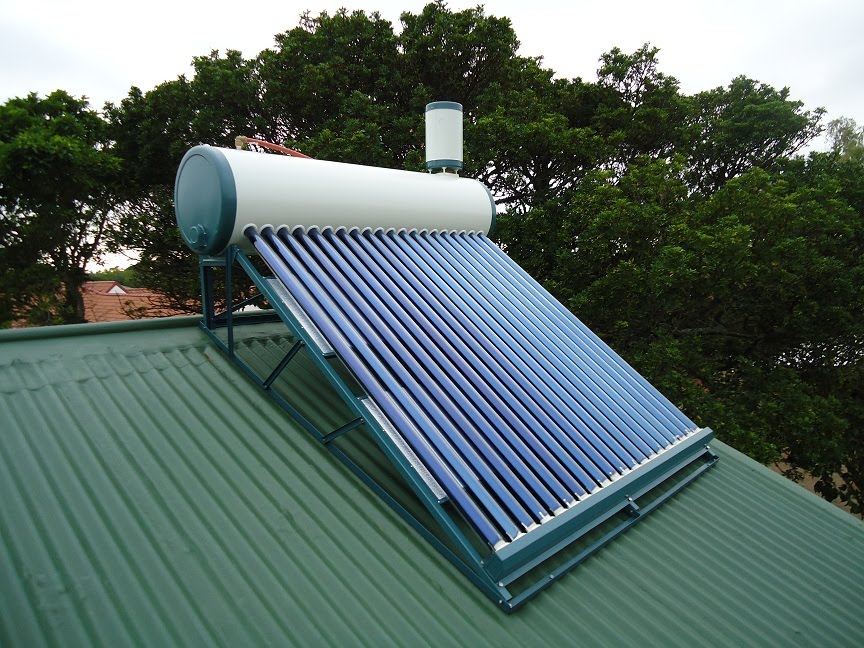
SOLAR WATER HEATING
After researching and writing the Herald article (see below) I finally took the plunge and "put my money where my mouth is" by spending precious cash on a low pressure solar water heater. The results are more spectacular than I ever would have imagined. I purchased a 200 litre low pressure system which has 20 evacuated tubes. I paid R6250. It has adequate water for 4 people to shower in the evening and amazingly the water is still piping hot the next morning. My initial concern was that the water would cool down after initial use due to the fact that cold water is added to the tank BUT amazingly the water remains hot. I assume that there is minimal turbulence in the tank and that the cold and hot water does not mix much. After one week it seems that I am saving an average of 10kW.h per day. At R0.85 /kW.h this is R8.50 per day. This does not sound like much but it means that after 735 days the hot water is free!! Plus its means that there is a little bit less smog in Mpumalanga!!
GREEN LAB UP AND RUNNING!
Yesterday afternoon we made the final connections and we are finally harvesting renewable energy! Even though there was cloud cover the solar panels alone were making over 400W. Today that will increase to around 1kW. Riaan has mastered the programming of the various controllers and the system is running well. Right now there is a course running in the lab and the delegates are using computers powered by renewable energy! Should we have a power failure or load shedding they will continue working without any interuption!
Soon we will have the portal running where we display the data regarding energy harvested.
Soon we will have the portal running where we display the data regarding energy harvested.

Wednesday, January 19, 2011
GREEN LAB
The PV panels are mounted as well as the horizontal axis turbine. As soon as we get the batteries connected we'll be able to direct some green power to them. The controllers and inverter are connected and even the "green" plug points in the lab below are ready for use. The small vertical axis savonius turbine is our green streetlight design. This switches on after dark and illuminates the area at night. Probably within a week the system will be up and running. The final phase will be the web portal to show actual energy harvested in real time. 

Monday, January 10, 2011
Rooftop Helical Savonius


In our continual quest for a "domestic friendly" wind turbine we are experimenting with yet another possible mounting method for the helical savonius....horizontally on the crest of a pitched roof. Provided the roof is orientated perpendicular to the prevailing winds this holds advantages;
1) No mast is required
2) The airflow is accelerated over the crest of the roof
A 20% increase in windspeed results in a 70% increase in power generated!
Wednesday, January 5, 2011

Friday, December 10, 2010
NMMUGREEN exhibit at Bayworld


NMMUGREEN was invited to exhibit at the "story of stuff" green exhibition at Bayworld. We displayed two vertical axis turbines (helical savonius rotors) as well as our 2kW inverter and wind turbine controller. Riaan, Stephan, Jarred and Marelize fielded a variety of questions from the public. Most questions related to the viability of installing such systems at home. The "green street light" turbine also seemed to generate a lot of interest. All in all a successful event thanks to the planning and hard work of the "green team" - well done guys! Thanks also to Nelius de Lange from J&J electronics for attending and assisting us with the setup of the inverter and the loan of the batteries. (J&J Electronics are manufacturers of Microcare inverters,MPPT controllers and other "green" electronic devices).
Thursday, December 9, 2010
Green powered lab

Three Mechanical Engineering BTech students (Riaan Opperman, Stephan de Beer and Jarred Hempel) have been tasked with installing solar and wind power to a computer lab in the "E" block of the North Campus. They have run the project from concept stage all the way through to installation. Progress has been brisk and we hope to power up 1/4 of the lab on green power by early January. 1000W of PV is being installed as well as horizontal and vertical axis turbines. MPPT solar and wind charge controllers will feed 1000Ah of lead acid battery storage. A 2kW inverter with data logging and network interface will complete the package. Live data will be available on a web portal showing how the system performs. The system will serve as a pilot project for the NMMU to test the viability of green powered buildings and will provide the man in the street with real unbiased data on which to base purchasing decisions for green energy components.
A pic is attached showing the team constructing the PV mounting framework. More pics to follow soon as the various components are installed on the rooftop.
Sunday, October 3, 2010
HYDRO ENERGY TESTING

It works!
17 litres per hour at 8.5m head with river flow of approximately 0.5m/s.
Whilst 17 litres per hr does not seem like much it equates to over 400l per day...almost enough for an average household.
Now to scale up and refine the design...
Monday, September 13, 2010
SAVONIUS ROTOR IN ACTION

The Savonius rotor shown earlier in this blog is now permanently installed at a filling station in Kareedouw. It, together with a PV array provide most of the energy requirements for the fuel pumps at this filling station. Green energy pumping fossil fuel...!!!
This is believed to be one of the first (or perhaps the first) commercial installation of a Savonius rotor in SA.
Wednesday, September 1, 2010
HYDRO POWER FROM A FLOWING RIVER

Hydro power is a well known source of "green" power that normally harnesses the potential energy of water whilst it flows from a high region to a lower region. The difference in height is referred to as "head".
Another source of hydro power is from moving water such as in a fast flowing stream or river and in tidal estuaries. .
Few, if any, viable devices are known to be in existence.
As a starting point I decided to fabricate a very simple floating water wheel driving a double acting piston/cylinder arrangement. The size of the pistons and the stroke used give a pumpimg volume of 0.12 litres per revolution. Calculations show that a river flowing at 1m/s should turn the wheel at approximately 20rev/min and pump 144 litres/hr against a head of up to 40m. If the river flows all day, every day then this works out to over a million litres per annum! If it works this would be an ideal low cost and green solution for farmers or communities that live near moving water.
The plan is to test the device later this month....pics to follow!
Tuesday, August 10, 2010
Wind Turbine at Coega

Here is a close up view of the new turbine at Coega. It is a 1.8 MW unit with a hub height of 95m and blade diameter of 80m.
Monday, July 12, 2010
Sunday, July 11, 2010
Test rig complete


The test rig is now complete and ready to be put into service. A helical savonius turbine on loan from a local company has been mounted on the test rig and will be used to setup the data logging equipment and do some trial testing. Quite soon we will be in a position to offer a testing service for developers of small turbines. The rig will also be used for Wetsi Nkholise and Noel Weyer's MTech research projects and others. Riaan's design of the test rig is sturdy, practical and well thought out - well done!
Thursday, June 3, 2010
NMMU test rig


Our testing using the trailer (mobile test rig) has worked so well that we have decided to build a proper custom made unit. Riaan Opperman (BTech Mech Eng student) has been tasked with the design. He came up with a novel hydraulic lift system which will take the back breaking work out of lifting and lowering the mast. When not being used as a mobile rig the unit will be parked at a suitable windy spot with the mast up and testing will continue.
Funding for the test rig has been kindly provided by the NMMU with a view to using it for student projects as well as testing of outside client's small wind turbines. We should be able to provide a full power curve for any small wind turbine in a relatively short period of time.
Friday, January 29, 2010
Gys Kleyn's SWH project


Solar Water Heat Collector comparison developmental tests.
To do a comparative performance study between an ISO accredited flat tube-fin type Domestic Solar Water Heat Collector and an unaccredited version under development.
For a DSWH collector manufacturer to have any such performance type testing done is a lengthy and expensive exercise which is seen as a stumbling block by such manufacturers.
For this reason, manufacturers tend to stick to existing designs and only concentrate on enhancing the effectiveness of these designs through more precise controls.
People want hot water in their homes. It must be available on demand, and the provision thereof must not add complexities to their daily lives. This is why electrically heated water will always be the more attractive option as long as the cost of operating such a system does not become inhibitive. After installing an electric water heater, normally totally out of view, it is usually forgotten about.
For any alternative method of providing domestic hot water to become widely accepted, it will have to offer the same type of “out of mind” simplicity and ease of operation, with cost being a major influencing factor. That is cost of the initial installation, as well as the average monthly running cost. These costs are obviously directly influenced by any investment made during development and manufacture of such a water heater.
The harvesting of solar energy to heat water for domestic use is not new. The majority of devices used and developed for this purpose over the years have been expensive and whilst technically simple, manufacturing them on a large-scale production have been intricate.
South Africa has 46 million inhabitants living in approximately 20 million domestic houses? Of which about 50% are owned by the inhabitants. The current installation cost of an appropriate all-electric system is in the region of ± R5000. These systems will usually last in excess of 20 years, needing only an occasional element or thermostat replacement of relatively minor cost implication.
The cost of high quality Solar Water Heating systems are typically around R35000. These are available as direct imports from Europe, America and Australia. These systems have been developed utilising the latest computerized system controllers and manufacturing techniques. The level of expertise required to install, service and repair these systems, in addition to the high initial cost is a further deterrent for being used in rural areas. However these systems are considered the benchmark in terms of performance, hence such a flat plate copper tube and aluminium fin collector coupled to a hot water storage vessel will be used in this comparative study.
The performance study will be an outdoor comparative study. Usually such a study relies on repeatable sun-days such that valid comparative tests can be replicated. This usually takes a very long time to achieve. To eliminate or reduce this problem, two test stands will be built whereupon the two systems for comparison will be mounted and tested. In this manner tests will be done simultaneously, hence the problem of replicating sun load, cloud movement etc, is eliminated.
The objective is not to classify the performance of the systems being tested, merely to see how they compare. It is envisaged that this method of testing may lead to the definition of a methodology for doing developmental testing, as opposed to doing testing for accreditation purposes.
Problems normally associated with conventional accreditation testing are:
1) High costs
2) Lengthy waiting periods due to scheduling at SABS testing facilities.
3) Lengthy test duration due to ambient and weather condition replication requirements.
To do a comparative performance study between an ISO accredited flat tube-fin type Domestic Solar Water Heat Collector and an unaccredited version under development.
For a DSWH collector manufacturer to have any such performance type testing done is a lengthy and expensive exercise which is seen as a stumbling block by such manufacturers.
For this reason, manufacturers tend to stick to existing designs and only concentrate on enhancing the effectiveness of these designs through more precise controls.
People want hot water in their homes. It must be available on demand, and the provision thereof must not add complexities to their daily lives. This is why electrically heated water will always be the more attractive option as long as the cost of operating such a system does not become inhibitive. After installing an electric water heater, normally totally out of view, it is usually forgotten about.
For any alternative method of providing domestic hot water to become widely accepted, it will have to offer the same type of “out of mind” simplicity and ease of operation, with cost being a major influencing factor. That is cost of the initial installation, as well as the average monthly running cost. These costs are obviously directly influenced by any investment made during development and manufacture of such a water heater.
The harvesting of solar energy to heat water for domestic use is not new. The majority of devices used and developed for this purpose over the years have been expensive and whilst technically simple, manufacturing them on a large-scale production have been intricate.
South Africa has 46 million inhabitants living in approximately 20 million domestic houses? Of which about 50% are owned by the inhabitants. The current installation cost of an appropriate all-electric system is in the region of ± R5000. These systems will usually last in excess of 20 years, needing only an occasional element or thermostat replacement of relatively minor cost implication.
The cost of high quality Solar Water Heating systems are typically around R35000. These are available as direct imports from Europe, America and Australia. These systems have been developed utilising the latest computerized system controllers and manufacturing techniques. The level of expertise required to install, service and repair these systems, in addition to the high initial cost is a further deterrent for being used in rural areas. However these systems are considered the benchmark in terms of performance, hence such a flat plate copper tube and aluminium fin collector coupled to a hot water storage vessel will be used in this comparative study.
The performance study will be an outdoor comparative study. Usually such a study relies on repeatable sun-days such that valid comparative tests can be replicated. This usually takes a very long time to achieve. To eliminate or reduce this problem, two test stands will be built whereupon the two systems for comparison will be mounted and tested. In this manner tests will be done simultaneously, hence the problem of replicating sun load, cloud movement etc, is eliminated.
The objective is not to classify the performance of the systems being tested, merely to see how they compare. It is envisaged that this method of testing may lead to the definition of a methodology for doing developmental testing, as opposed to doing testing for accreditation purposes.
Problems normally associated with conventional accreditation testing are:
1) High costs
2) Lengthy waiting periods due to scheduling at SABS testing facilities.
3) Lengthy test duration due to ambient and weather condition replication requirements.
G. Kleyn
28 January 2010
28 January 2010
Tuesday, January 26, 2010
Durability testing begins

A suitably exposed and windy spot (34° 6'9.59"S
24°52'56.89"E) is the new home of the helical savonius for the next month or so. Hopefully we'll get a few gales and that everything will stay in one piece!
24°52'56.89"E) is the new home of the helical savonius for the next month or so. Hopefully we'll get a few gales and that everything will stay in one piece!
Thursday, January 21, 2010
Savonius versus HAWT

 It is evident that the Savonius shape (green) needs to be larger than the HAWT shape (blue) to be able to produce similar amounts of power. The very low blade tip speed of the Savonius however results in some very positive attributes, namely:
1) Virtually silent operation - (suitable for use in residential areas)
2) Structural advantages - (low centrifugal loads)
3) Safety - (less chance of catastrophic failure and related losses)
4) Visible to birdlife whilst rotating


Monday, January 18, 2010
Concentric or not?


Initially I wanted the rotor to run on the mast (like the pic in the previous posting). Unfortunately this is noisy so I elected for a side mounting instead. The latter has advantages in that the turbine can be mounted on a variety of different size masts. It can also be pre-assembled, balanced and test run prior to arrival at the site. The other images show the logging equipment and a preliminary graph showing yesterday's results on the double rotor unit (top pic). The mobile test rig works well provided you have access to a nice long aircraft runway!
Adding a twist


Apart from looking like a really cool xmas decoration... a twisted savonius produces smoother torque and is likely to start more easily from any position. I had to build one....!
The shape is more complex than one thinks and started with a CAD model followed by a plug, mould and then the final parts. I experimented with different generators, starting with a home made 48 magnet setup (as shown in the top pic) to a geared up brushless generator. Testing in this department continues.....watch this space!
A fresh look at the savonius rotor


Wind turbine experts the world over seem to rate turbines according to one criteria.....POWER COEFFICIENT....
Power coefficient is simply the percentage of the wind's kinetic energy that is harvested. In other words it is the electrical output power of the turbine divided by the total kinetic energy of the wind. (Typically HAWT's can get around 35-40% and Savonius rotors get about 15-25% ....meaning that they generally don't even get on the shortlist!!)
The total kinetic energy of the wind is calculated by multiplying:
- air density (1.208kg/m^3 at sea level)
- 0.5
- wind velocity cubed (in m/s)
- cross sectional area of the air mass being considered (m^2)
Answer will be in Watts (W)
BUT ......there is (in my opinion) more to consider than just the projected area of the wind turbine and based on this I do believe that Savonius Rotors definitely deserve another look!!! More about this later...
So I persuaded a local company (Energy Solutions Africa) that they should look at a Savonius for their hybrid system. What followed was another year of tinkering (a nice word for development on a beer budget!). One of the biggest problems was finding a suitable generator that could work across the wind speed spectrum and that would be efficient and affordable. Initial attempts involved small (cheaper), fast turning generators. These were geared up by various means. In an attempt to minimise losses one such attempt involved a 2m diameter sprocket which we manufactured from a number of laser cut pieces. The most elegant soloution turned out in the end to be an enormous directly driven generator that could cope with the power requirements across the whole speed spectrum purely by virtue of its size. Price was high but with all things considered it was the best solution. ESA is finalising a few prototype machines at present which will after further testing hopefully lead to many installations in Africa.
The bottom line is that this turbine is:
- totally quiet....you could install it in a suburban neighbourhood without your neighbour even hearing it
- It is highly visible to our feathered friends....meaning that eveyone is happy (us greenies included!)
- It accepts wind from any direction (without the need of a tail and/or a swivelling head as on a HAWT)
- It occupies a rectangular piece of sky somewhat larger than the circular piece of sky needed by the equivalent power HAWT .....but hey...the sky is still free!!
- The blade tips are moving at about 1 to 1.2 times the speed of the wind where the HAWT'S samurai swords are slicing through the air at between 5 and 7 times the speed of the wind!!
Monday, January 4, 2010
Reciprocating aerofoil wind energy harvester

Evolution driven by months of tinkering saw the device grow from having one aerofoil to two to eventually three. Each aerofoil was allowed to pivot freely. Each aerofoil was fitted with a tail. The tails were controlled by cams fixed to the rotating arms. Eventually a workable device was achieved with a power coefficient of around 15%, very high starting torque and slow rotational speed.
Pros: high torque, quiet, safe
Cons: Electrical generators not easily matched to slow rotational speed, power coefficient lower than most HAWT's (horizontal axis wind turbines)
Revolve rather than reciprocate

Reciprocating motion is great for pumping water but for generating electricity, rotation is probably better suited. With this in mind we decided to rather try and power a shaft by means of the reciprocating aerofoils. The idea was to change the angle of attack of the aerofoils every half revolution to achieve rotation of the shaft in one direction.
Controlling the aerofoil by adding a tail
By adding a tail and controlling its angle rather than that of the main aerofoil, control was achieved with a much smaller force. The tail was controlled automatically via a mechanical system of cables, springs and an "over centre" mechanism to achieve automatic reciprocating motion.
Controlling the aerofoil

Changing the direction of the lift force (to get a reciprocating action) required changing the angle of attack of the aerofoil. Ideally this was supposed to happen automatically and require as little force as possible. By hinging the symmetrical aerofoil at its quarter chord the moment required was kept to a minimum however the inertia of the aerofoil still necessitated a larger than ideal controlling force.
Saturday, December 12, 2009
Power equals force times velocity

Generating a substantial force by placing an aerofoil in the wind at an appropriate angle is relatively easy.....But getting the force to do work and ultimately generate power is more challenging!
Remember the idea was to "think outside of the box".....our first device had a long counterbalanced arm to which our aerofoil was attached. The idea was to get the arm to reciprocate automatically. The reciprocating action would then be used to generate electricity or pump water.
Aerofoil in the wind


Devices that harvest energy from the wind do so by generating a force (either due to drag or lift) and somehow utilise this force to do work. The most common are the horizontal axis wind turbines (HAWT). These work well enough BUT perhaps there is a better, cheaper, quieter way of doing it.....That is where all of this started!
Here are pics of our first aerofoil...June 2006
Subscribe to:
Posts (Atom)